The Business Office Tax is a type of local tax and is a special-purpose tax levied on entities conducting business in offices or workplaces within cities that have a population of 300,000 or more. It is designed to fund the development and improvement of urban environments—such as roads, urban rapid transit, parking facilities, and water/sewage systems—based on the benefits these businesses receive from city administrative services.
Taxing Entities
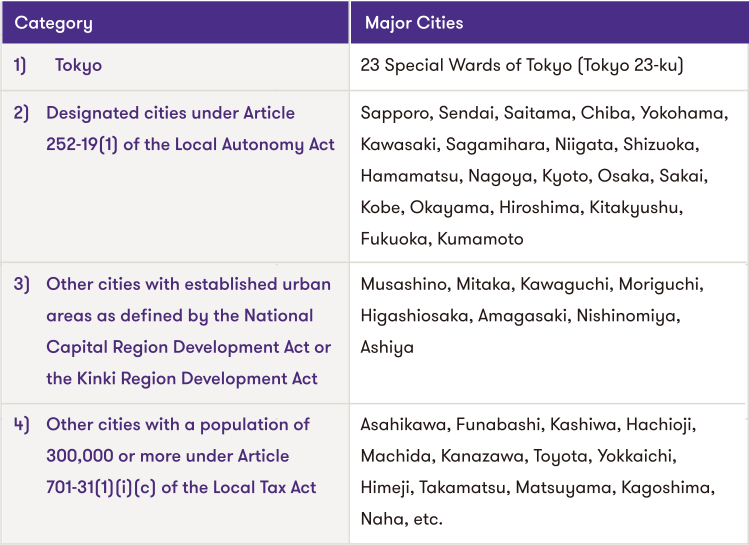
This tax is levied by cities with a population of 300,000 or more. As of March 31, 2026, there are 77 such municipalities (hereinafter referred to as "Designated Cities, etc."), which primarily include the following:
![Taxing Entities]()
Taxable Object and Taxpayer
Taxable object is businesses conducted at an office or workplace. Taxpayer is the individual or corporation conducting the business.
Filing and Payment Deadline
- Corporations: within 2 months after the end of their fiscal year.
- Individuals: by March 15 of the following year.
Tax Base, Tax Rate and Exemption Threshold
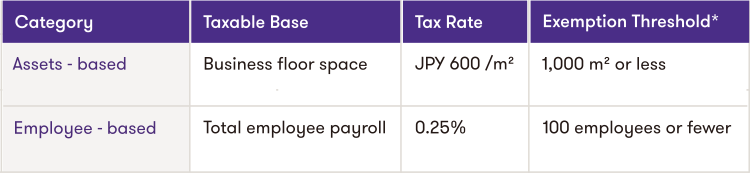
The tax is calculated based on two categories: the assets-based and the employee-based. The taxable base, tax rates, and exemption thresholds for each are as follows:
![Tax Base, Tax Rate and Exemption Threshold]()
* Under local ordinances, some Designated Cities, etc. may require the filing of a tax return even if the figures are below the exemption thresholds. For example, a filing obligation arises even though no tax payment is required if:
- In Tokyo 23-ku, the total floor space exceeds 800 m² or the number of employees exceeds 80;
- In Yokohama City, the area exceeds 700 m² or the number of employees exceeds 70.
In addition, in Tokyo 23-ku, a tax return must be filed regardless of the current figures if the taxpayer had a tax liability in the previous fiscal or calendar year.
Exemption Threshold Determination
The methods for determining whether the individual or corporation falls under the exemption threshold are as follows:
1) Determination Timing
The actual status as of the last day of the fiscal year for corporations and as of December 31 for individuals. The exemption eligibility is determined for assets-based and employee-based respectively.
2) Determination Unit
The determination is based on the following two factors, calculated by aggregating all business offices located within each Designated Cities, etc.:
(1) Total floor space including a proportional share of the common areas (such as corridors, stairs, elevators, pipe spaces, and electrical/mechanical rooms), excluding any tax-exempt portions.
(2) Total number of officers paid salary and employees, excluding elderly individuals defined as persons aged 65 or older, persons with disabilities and the number of employees covered by the tax exemption. This exclusion does not apply to officers paid salary.
Example
If there are two offices in Tokyo 23-ku as of the last day of the fiscal year:
- Office A: 500 m² / Office B: 600 m² Total: 1,100 m²
Since it exceeds 1,000 m², the taxpayer is obligated to file and pay the "assets-based" component.
- Office A: 50 employees / Office B: 60 employees (as of the last day of the fiscal year*) Total: 110 employees
Since it exceeds 100 employees, the taxpayer is obligated to file and pay the employee-based component.
* If there are significant fluctuations in the number of employees (meaning cases where the maximum number of employees at the end of any month during the calculation period exceeds twice the minimum number of employees), the number calculated through a special formula shall be deemed the employee count as of the last day of the fiscal year.
3) Deemed Joint Business
If an individual or corporation has a "special related party" (such as a relative or a family company) and both conduct their businesses on the same building, their businesses are deemed to be a joint business.
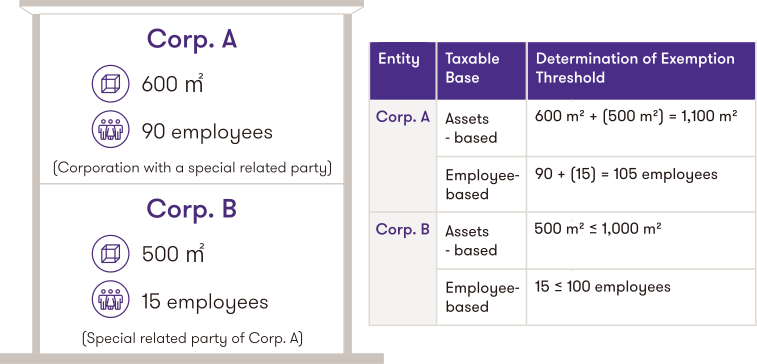
This system is designed to prevent tax avoidance by splitting a single business into multiple entities to stay below the exemption thresholds. When this rule applies, only the party that has a "special related party" determines its exemption threshold based on the combined total of floor space and employees of both businesses. The "special related party" itself determines its threshold based solely on its own business.
(1) Requirements
The rule applies when the following conditions are met:
- Special Related Party: Refers to individuals with a special relationship to the operator (such as spouses, direct blood relatives, or those sharing a livelihood) or "family companies" (companies where three or fewer shareholders and their special related parties hold more than 50% of the shares, voting rights, etc.).
- Same Building: The businesses must be conducted within the exact same building block. In principle, separate buildings do not count as the same building.
Even if operating in the same building, the businesses are exempted from this rule if BOTH of the following conditions are met:
- Not Conducted Through Mutual Intention: There is objectively no mutual communication or intention between the parties to operate together (e.g., coincidentally sharing a building due to a public redevelopment project)
- No Unreasonable Tax Avoidance: The arrangement does not result in an unreasonable avoidance of the Business Office Tax burden, meaning the tax amount would not be reduced regardless of whether this rule is applied.
(2) Exemption Threshold Determination
To determine if those who have a “special related party” exceed the tax exemption threshold, they must combine their own business's floor space and number of employees with those of the special related party's business (within the same building).
Example
When Corporation B’s business constitutes a “deemed joint business” of Corporation A
![Exemption Threshold Determination]()
Only Corporation A exceeds the exemption threshold for both the assets-based and employee-based components.
Service
Learn more about how our International Tax Services can help you